
This post contains affiliate links. If you purchase through my links I earn a small commission, at no extra cost to you. I only recommend products I have tested and use myself.
How to Pack Carry-On Only for Remote Work: The System I Use Every Month
Most carry-on guides are written by people who take one trip a year. This one is written for women who work on the move — where the laptop is non-negotiable, the bag has to close, and the airline can’t hold you hostage at the gate.
At some point, every woman who travels with a laptop figures out the same thing: a checked bag is not a convenience. It’s a dependency. It means waiting. It means uncertainty. It means your work setup is in someone else’s hands for the duration of a belt carousel.
Carry-on only isn’t a packing challenge — it’s a design decision. Everything you need fits. The question is whether you’re packing for the trip you’re actually taking, or for every possible version of it.
The Mindset Shift First
Generic packing guides tell you to roll your clothes and use packing cubes. That’s not the problem. The problem is that most women pack for worst-case scenarios — what if it gets cold, what if there’s a formal event, what if the laundry doesn’t work. The bag fills up before the probable trip is even packed.
The shift: pack for the probable trip, not the possible one. You are going somewhere with shops, laundry, and options. The only non-negotiable is your work setup. Everything else is flexible.
Before packing anything, ask: if this item wasn’t in my bag and I needed it, could I solve it for under €20 in the destination city? If yes — leave it. The anxiety of not having it is not worth the weight.
Understanding the Real Constraint
Most carry-on bags are 40–56L. Airlines specify dimensions, not litres — typically around 55 × 40 × 20cm, though this varies. The Osprey Renn 50 I use sits within most major airline requirements and is designed specifically for women’s torso lengths, which matters more than most gear reviews acknowledge.
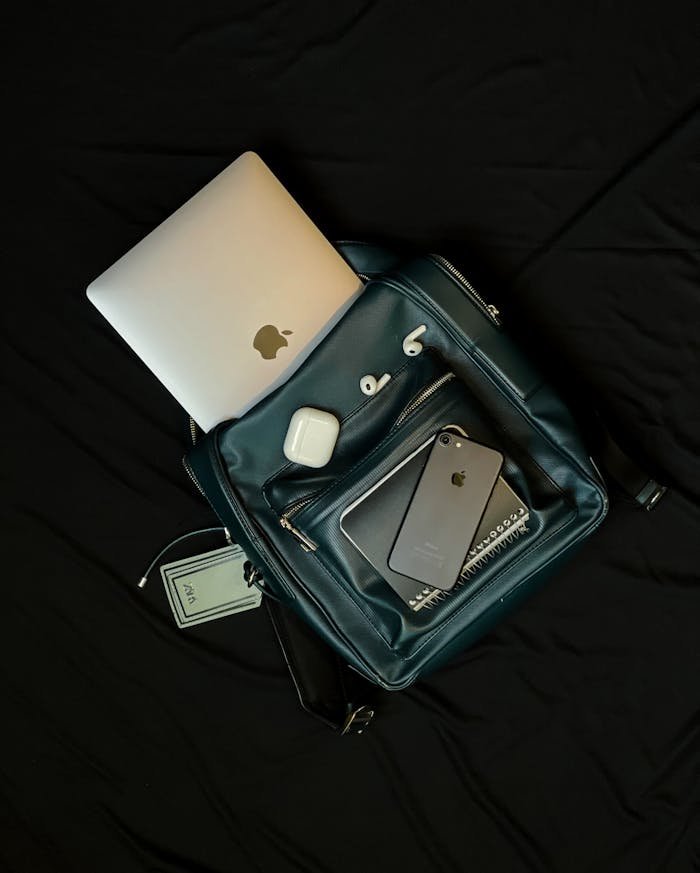
The remote worker’s challenge isn’t clothing — it’s tech weight. Before a single item of clothing goes in, a standard remote work setup already carries:
| Item | Approx weight |
|---|---|
| MacBook Pro 14″ | ~1,600g |
| Anker 737 power bank | ~630g |
| Cables + Bagsmart organiser | ~200g |
| Phone + eSIM | ~200g |
| Tech subtotal — before clothes | ~2,630g |
Tech is fixed weight. You cannot cut it without cutting your ability to work. Clothing is variable. That’s where the system lives.
The Packing System — Step by Step
Step 1 — Pack tech first, not last
Tech goes in first, organised and protected. This forces you to see exactly how much space remains before you consider clothes. Most people do it backwards — fill the bag with clothes, then panic-Tetris the laptop in at the end. That’s how you end up checking a bag.
Step 2 — The 3:2:1 clothing ratio
3 tops, 2 bottoms, 1 layer. This covers 5–7 days without laundry. Add a second set of workout clothes if you run. That’s it. The ratio works because bottoms repeat better than tops — nobody notices you’ve worn the same jeans twice. A cardigan or lightweight jacket is the layer; it doubles as an extra warmth item on the plane.
Step 3 — Packing cubes as a compression and organisation system
One cube for clothes. One cube (or pouch) for cables. Packing cubes don’t create space — they create order, which stops you from overpacking because you can see exactly what’s in each cube before you close it. When the cube is full, it’s full. The decision is made for you.
Affiliate → Eagle Creek packing cubes — check current price on Amazon ↗Step 4 — The cable organiser is not optional
Loose cables are the silent enemy of a tight bag. They fill corners, tangle, and add the illusion of more weight than they have. A flat cable organiser keeps every cable, adapter, and plug in one place — and it’s the first thing out when you sit down to work.
Affiliate → Bagsmart cable organiser — check price on Amazon ↗Step 5 — Wear your heaviest items to the airport
Boots, jeans, the bulky layer — wear them. Your bag is weighed, not your body. This alone can save 600–900g of carry-on allowance.
Everything in My Bag
This is the exact list. Not aspirational. Not a brand deal list. What’s actually in the Osprey Renn 50 every trip.
- Personal safety alarm (She’s Birdie / SABRE) — 70g, keychain clip, 130dB. Goes on the bag strap or in the outer pocket every single trip. → Check price on Amazon
- Pacsafe bag clips — lightweight wire clips for zippers in crowded spaces. Airports, markets, overnight buses.
- Door alarm (Addalock / door stop alarm) — hostel rooms, Airbnbs, any door you’re not sure about. Weighs nothing. Earns its space every time.
This is the section every generic packing guide leaves out. A woman travelling solo isn’t just thinking about weight — she’s thinking about security. These items add under 200g and a measurable amount of calm. Worth a dedicated post — coming next month.
Two cards is the system: Wise for daily spending and international transfers at the real exchange rate, Revolut as backup. No cash beyond a small float. No blocked transactions when you cross a border. No fee surprises on the statement.
The Mistakes I Made First
Packing for worst-case, not probable. “What if it gets cold” adds a second jacket. “What if there’s an event” adds heels. “What if the laundry breaks” adds four extra days of clothes. None of it happens. All of it weighs 3kg.
Two pairs of shoes. One pair of shoes that can do everything — walking, a casual dinner, a coworking space — is enough. Wear the heavier pair to the airport. The second pair never justifies its volume.
The “I might need this” trap. Every item in the bag should pass the test: have I used this in the last three trips? If not, it’s a sunk cost feeling — not a need. Books, excessive toiletries, a travel iron. All of them have been in a bag I carried for two weeks and never touched.
Ignoring airline-specific size rules until the gate. Carry-on dimensions vary between airlines and are enforced inconsistently — but when they are enforced, it’s at the gate and the fee is painful. The Osprey Renn 50 fits within most major airline carry-on requirements, but check your specific route. Ryanair and EasyJet are the ones most likely to enforce this.
Pro Tips — What Actually Helps
Roll clothes, don’t fold
Rolling compresses more evenly than folding and reduces creasing in knit fabrics. Fold structured items like blazers — rolling distorts the shape.
The Osprey as a personal item on some airlines
On certain carriers, a 50L bag is too large for overhead — but not always enforced if it compresses. Know your airline. On budget carriers in Europe, the Renn 50 sometimes fits under the seat if soft-packed. Not guaranteed. Have a plan B.
The “touch it twice” rule
After three days in a destination, take everything out of the bag. If you haven’t touched an item in those three days, you didn’t need it. Leave it at the next accommodation, ship it home, or donate it. The bag gets lighter as the trip goes on.
eSIM before you land
Buy the Airalo regional plan 24 hours before departure. It activates on arrival. You clear immigration, walk to the taxi rank, and open Google Maps immediately. No fumbling with airport SIM stalls, no €15 roaming day-passes from your home carrier.
- Pack tech first — laptop, power bank, charger, cable organiser — before any clothing
- Apply the 3:2:1 ratio — 3 tops, 2 bottoms, 1 layer — and close the clothing cube
- Wear your heaviest shoes and thickest layer to the airport
- Check carry-on dimensions against your specific airline — not a generic guide
- Wise or Revolut card confirmed active and loaded — no foreign cash beyond a small float
- Airalo eSIM downloaded and tested before departure day
- Personal safety alarm clipped to outer pocket or strap
- Run the “touch it twice” test — anything you haven’t used in 3 days gets left behind next trip
- Need a power bank that actually charges a laptop at full speed? Anker 737 review — full test across multiple countries.
- Which carry-on backpack fits the system? Best carry-on backpack for digital nomads — tested and compared.
Next: the carry-on backpack that makes this system possible — the Osprey Renn 50 tested across airports, buses, and overhead bins on four airlines. Which ones actually fit it, and which ones don’t.